

The Women Who Built Mexican Cuisine: A Story That Starts in the Kitchen

Quick Answer
Mexican cuisine as the world knows it was built largely by women — in colonial convent kitchens, in family homes, and in recipe books that served as instruments of national identity. Their knowledge was not passed down in classrooms but through presence, practice, and memory. Understanding this history changes how you experience every dish.
The Kitchen as an Act of Creation
There is a phrase from Mujeres construyendo un mundo, a book published by the Instituto Nacional de Antropología e Historia documenting the recipe archives of the former Convent of Santa Mónica in Puebla, that stops you in your tracks:
"La cocina es un espacio en donde se tejen y ensanchan las relaciones sociales y comunitarias; una labor de mujeres… una memoria histórica que se transmite de generación en generación."
The kitchen is a space where social and community bonds are woven and deepened. A labor of women. A historical memory passed from generation to generation.
What the researchers found inside Santa Mónica's archive wasn't simply a collection of recipes. It was evidence that the kitchen — even behind convent walls — was a space of genuine creativity, cultural experimentation, and identity-building. The nuns of Santa Mónica were working with indigenous Mexican ingredients alongside techniques brought from Spain, France, and Italy, and in doing so, they were producing something entirely new. Something we now call Mexican cuisine.
How the Most Famous Dish in Mexico Was Born
The mole on your table today is a direct product of that process.
Historian Janet Long Solís documents that mole as we know it was created during the colonial period, most likely in Puebla in the 17th century. The word comes from the Nahuatl mulli — meaning sauce, stew, or preparation. What makes mole remarkable is its proportions: it contains roughly equal amounts of indigenous Mexican ingredients and European ones. It is, as Long Solís puts it, a model of the blending of two culinary worlds.
That blend didn't happen by accident. It happened in convent kitchens, where women had access to both worlds — the indigenous ingredients that arrived through family connections to surrounding communities, and the European techniques and flavors brought over through the colonial apparatus. The kitchen was one of the few spaces where that exchange could happen freely, without political consequence, guided purely by taste.
The result was mole. And mole changed everything that came after it.
Recipe Books as Nation-Building
Something remarkable happened in Mexico in 1831, just a decade after Independence.
The country's first printed recipe books appeared — and they were not purely practical documents. According to researchers Martínez Ocampo and Bak-Geller, these early cookbooks were published with a specific political intention: to help construct a national identity through food. A newly independent Mexico needed to define itself, and the kitchen was one of the most powerful tools available.
These recipe books did something quietly radical. They gave legitimacy and formal recognition to indigenous Mexican ingredients — chile, maíz, frijol, calabaza, quelites — by placing them alongside French, Italian, and Spanish preparations in the same volume. They used Nahuatl words to name ingredients and techniques, connecting the new nation to its prehispanic past. They documented regional diversity, making visible what any experienced cook already knew: that there is not one Mexican cuisine but many.
The mole of Puebla is not the mole of Oaxaca. The enchiladas of Sonora are not the enchiladas of San Luis Potosí. The chilaquiles of one region bear little resemblance to those of another. This diversity — documented, named, and preserved in recipe books created largely by women — is not a weakness in Mexican culinary identity. It is its greatest strength.
A Lineage That Reached This Kitchen
My paternal grandmother, Doña Conchita Morales, was born in Cholula, Puebla — a city so saturated with religious architecture that Hernán Cortés himself wrote to the King of Spain claiming it had as many temples as days in the year. Her father was a baker who also restored paintings and decorative elements for churches. The sacred and the handmade were part of daily life in their home.
When my grandma was young, she was sent to the convent — as many girls from Cholula were. It was there that she learned to cook. Not just recipes, but the logic of a kitchen: how to build flavors, how to manage fire, how to feed people well with what was available.
She brought that knowledge home. For years she taught cooking classes to the young women of Cholula preparing to marry — passing on not just technique but an understanding of food as something that holds a family together, that marks celebrations, that expresses care without words.
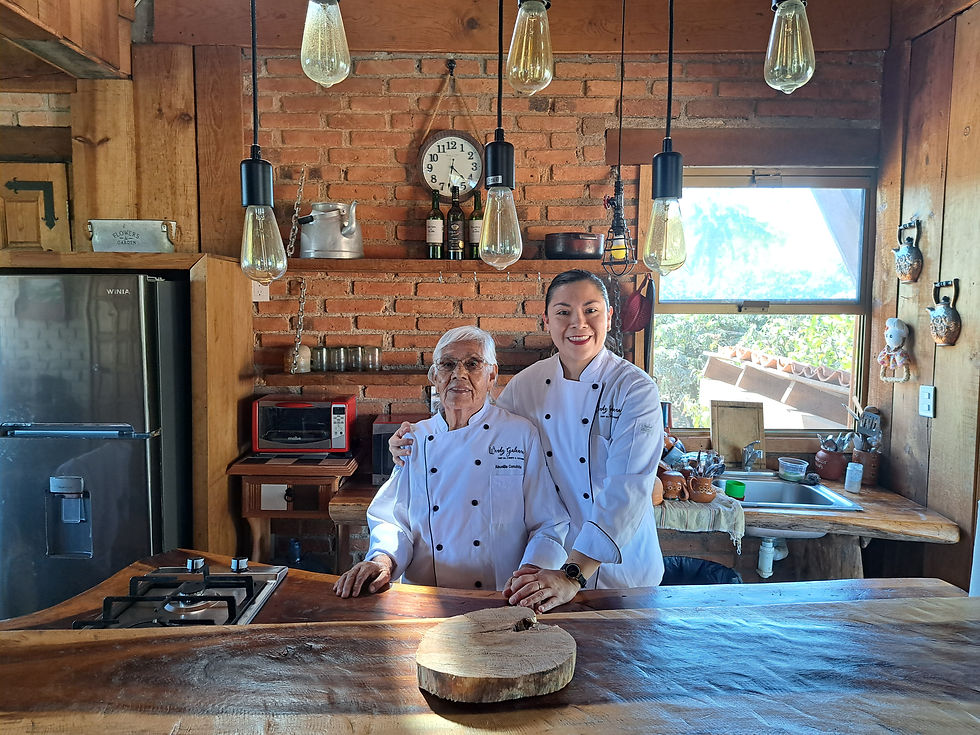
That tradition traveled from Cholula to Guerrero, through the women of my family, and eventually to this kitchen.
What This Means at the Table
When you sit down to a meal of authentic Mexican food — really authentic — you are eating the result of centuries of women's knowledge, creativity, and quiet persistence. The chile in the sauce was chosen deliberately. The way each ingredient was prepared follows a logic developed across generations, refined in convent kitchens, documented in recipe books, and carried forward in family homes across every region of this country.
This is not nostalgia. It is context. And as the anthropologist Sidney Mintz observed, food is never simply eaten — its consumption is always conditioned by meaning. The meaning behind Mexican food is as deep as its flavor.
When I cook in Puerto Vallarta, Punta Mita, or Sayulita — the sopecitos, the Guerrero-style barbacoa, the chiles en nogada, the tetelas, the mole, and even a simple plate of eggs with rice — these dishes carry that history. The memories of my two grandmothers: one from Guerrero, one from Puebla. Two regions, two traditions, two ways of understanding fire and flavor that over time blended in my kitchen and became something of my own. I'm not just cooking dinner. I'm continuing something they started.
The Best Way to Experience This Tradition
Reading about Mexican culinary history is one thing. Tasting it — at a table in a villa with the Pacific in the background, every dish made from scratch with ingredients that carry centuries of meaning — is something else entirely.
If you're curious about where the food on your plate comes from, a cooking class with me is a natural place to start. We'll cook together, use the ingredients that define this tradition, and talk about what makes each dish what it is.
Or if you simply want a beautiful dinner — one that carries this history in every course — that's what I'm here for too.
📲 WhatsApp: +52 322 164 8442 ✉️ wendy@personalchefwg.com 🌐 Book a cooking class or dinner

Comments